
Watches
Rolex Daytona: A Brief History of Going Fast
From a racing driver’s instrument to a collector’s obsession, the Cosmograph Daytona has covered a remarkable distance without losing its shape.
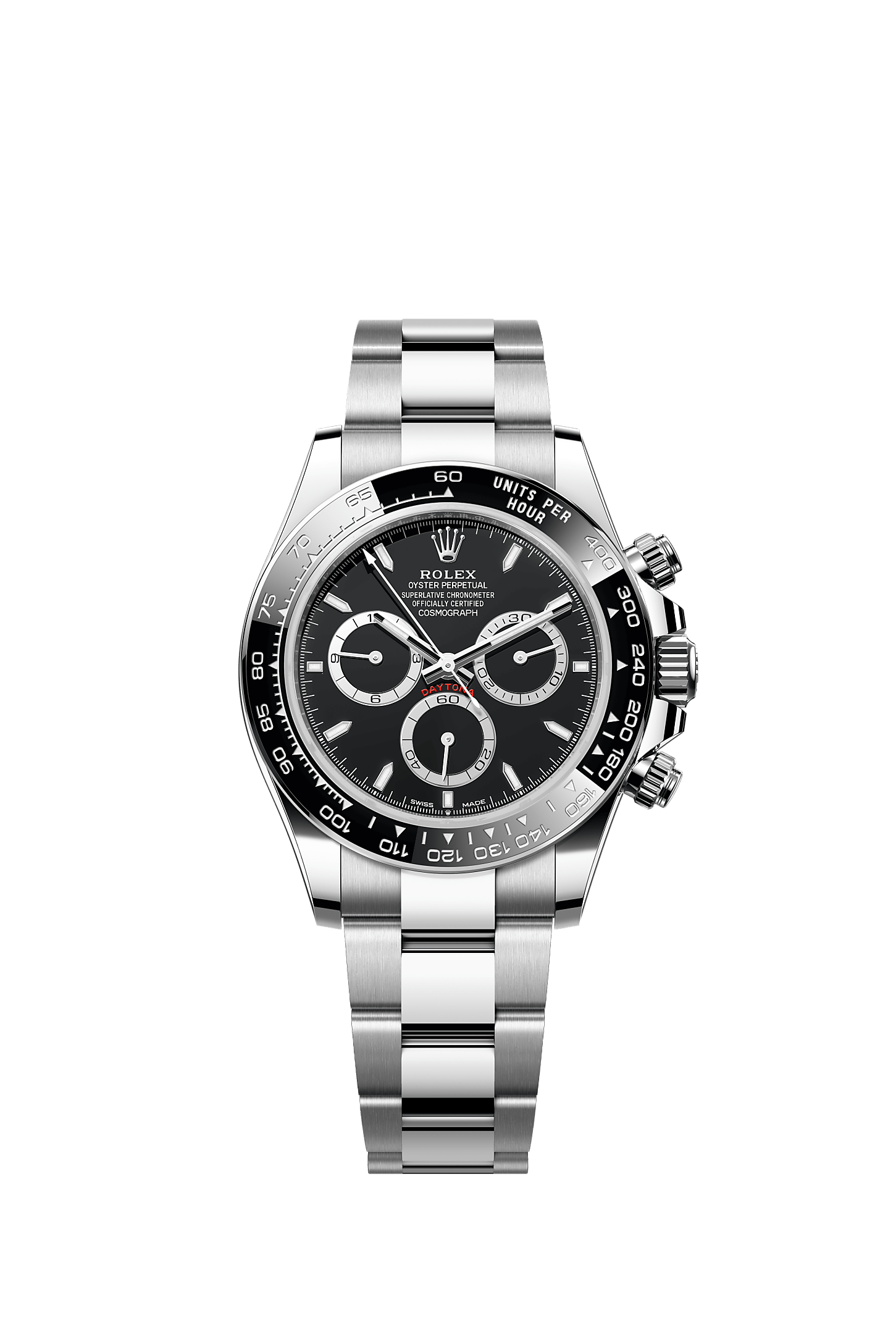
A Rolex Daytona will not make you a better driver. It won’t lower your handicap, either, although it can give you something more agreeable to study while your playing partner explains why his eight should really have been a five. What it offers is a compact piece of mechanical history, with enough racing pedigree, Hollywood glamour and engineering to justify a conversation considerably longer than the average backswing.
The remarkable part is how little of that glamour was necessary at the beginning. The Daytona had a job to do.
A name earned at speed
Rolex introduced the Cosmograph in 1963 for motor racing professionals. The connection with Florida was already established: Rolex dates its partnership with Daytona International Speedway to the circuit’s opening in 1959. The Daytona name appeared on some early watches intended for America before becoming standard. Rolex’s historical timeline: https://www.rolex.com/watches/cosmograph-daytona/beyond-the-racetrack
The watch’s purpose explains its face. A chronograph measures elapsed time, while the numbered tachymeter bezel lets the wearer calculate average speed over a known distance. Those little registers are working instruments, not decorations added because someone in marketing thought the dial looked lonely. That functional arrangement remains central to the Daytona’s identity. Rolex’s Daytona overview: https://newsroom.rolex.com/watches/oyster-collection/cosmograph-daytona
In 1965, a version with screw-down chronograph pushers arrived, improving protection against water entering through accidentally operated buttons. The Oyster name appeared on the dial, and a black Plexiglas bezel provided a different look. The broad outlines of a collecting obsession were taking shape, although the queues were still some way off. Rolex’s historical timeline: https://www.rolex.com/watches/cosmograph-daytona/beyond-the-racetrack
The slow starter
It is tempting to imagine every Daytona leaving the factory with a waiting list attached. The early history was less triumphant. Sotheby’s describes sluggish initial sales and retailers discounting watches to move stock. The first generation used hand-wound movements, and the variations in dials, pushers and bezels that collectors now examine so carefully accumulated over the years. Sotheby’s history: https://www.sothebys.com/en/articles/the-history-of-rolex-daytona and collector’s guide: https://www.sothebys.com/en/articles/how-to-start-collecting-the-rolex-daytona
That reversal is part of the attraction. A watch once passed over becomes the watch everybody wishes they had bought. Car enthusiasts will recognize the plot immediately, usually while discussing something they sold in 1982 for roughly the price of a respectable lawn mower.
Still, mechanical evolution alone would not have given the Daytona its most famous human connection. For that, it needed Paul Newman.
The Newman effect
Newman’s personal reference 6239, catalogued by Phillips as a 1968 watch, carried an exotic dial and a message from his wife, Joanne Woodward: “Drive Carefully Me.” It was an unusually persuasive combination of romance, celebrity and actual use. Here was a watch attached to a life, rather than simply photographed beside one. Phillips’ catalogue entry: https://www.phillips.com/detail/ROLEX/NY080117/8
The collector nickname “Paul Newman” came to identify a particular exotic-dial style. It does not mean that Newman owned every watch described that way. His own example was something quite different: the watch that helped give the others their name.
On October 26, 2017, Phillips sold it in New York for $17,752,500. At the time, that was a world auction record for any wristwatch. The bidding lasted twelve minutes. Most of us need longer than that to decide whether the hotel breakfast is worth the supplement. Phillips’ sale report: https://www.phillips.com/article/18461746/paul-newmans-paul-newman-rolex-daytona-sets-record-fetches-17-dollars-8-cents-million
That price belongs to that watch and its provenance. It is not a useful valuation shortcut for every elderly Daytona with an attractive dial.
The automatic revolution
In 1988, the Daytona entered a new mechanical era. Rolex’s calibre 4030 was based on the Zenith El Primero, extensively modified for Rolex’s requirements. The new generation brought automatic winding, a 40 mm case and a sapphire crystal. Collectors still refer to these watches as “Zenith Daytonas,” a convenient description of their mechanical ancestry. Sotheby’s Zenith Daytona guide: https://www.sothebys.com/en/articles/the-rolex-daytona-zenith-a-sothebys-guide
This was a significant modernization, but the basic personality survived. Three registers, a purposeful bezel and a shape that suggested action even when the most demanding event on the schedule was lunch. The Daytona had become easier to live with without looking as though it had retired from competition.
Rolex took the next major step in 2000 with calibre 4130, a self-winding chronograph movement developed and manufactured in-house. Its chronograph mechanism used fewer components. There is something pleasing about that approach: improvement through simplifying the machinery rather than making the specification sheet longer. Rolex’s history, 2000–2013: https://www.rolex.com/about-rolex/history/2000-2013
Familiar face, newer machinery
Ceramic brought another visible change. Rolex introduced a Cerachrom bezel to the Daytona in 2011; the steel model gained its black ceramic bezel in 2016. The darker frame gave the familiar dial a crisp outline and recalled the black-bezel vintage watches without copying their materials. Rolex’s timeline: https://www.rolex.com/watches/cosmograph-daytona/beyond-the-racetrack and contemporary 2016 launch coverage: https://www.hodinkee.com/articles/the-new-rolex-daytona-now-with-black-cerachrom-bezel
For its sixtieth anniversary in 2023, the Daytona received revised dial and case details and calibre 4131. Platinum versions gained a transparent case back, allowing the owner to admire machinery previously hidden from view. The current 4131 offers approximately 72 hours of power reserve. Rolex’s timeline: https://www.rolex.com/watches/cosmograph-daytona/beyond-the-racetrack and movement specifications: https://newsroom.rolex.com/watches/oyster-collection/cosmograph-daytona
Across those changes, the Daytona has remained recognizable. That consistency is more interesting than a succession of dramatic reinventions. Put an early example beside a modern one and the family resemblance explains itself.
The appeal also changes with the generation. An early hand-wound watch asks you to participate in its daily routine. An automatic brings a different sort of convenience. Neither preference needs a committee ruling. The same person can appreciate the character of an older sports car and still want air conditioning on the drive home. With the Daytona, that choice comes wrapped in a design language shared across decades. Understanding which chapter attracts you is far more useful than memorizing the reference number somebody else has decided you ought to want.
For an Affluent Golfer reader, the appeal needn’t involve a racing licence or an auction paddle. It can be the pleasure of a well-resolved object, a good story and engineering you can carry to dinner.
The Daytona began with the practical business of measuring speed. Its greater achievement has been making people want to slow down and look at it.
Image credits: Cover — Rolex Cosmograph Daytona ref. 126500LN, courtesy of Rolex: https://www.rolex.com/en-us/watches/cosmograph-daytona/m126500ln-0002. Gallery — circa 1963 ref. 6239, courtesy of Phillips: https://www.phillips.com/detail/rolex/NY080322/31; Paul Newman’s personal 1968 ref. 6239, courtesy of Phillips: https://www.phillips.com/detail/ROLEX/NY080117/8; late-1990s ref. 16523, photograph by Clyde94 / Wikimedia Commons: https://commons.wikimedia.org/wiki/File:Rolex_Daytona_ref._16523,_fine_anni_%2790.jpg, CC BY-SA 4.0: https://creativecommons.org/licenses/by-sa/4.0/, resized for display.
