
Editorial
Have Six-Iron, Will Travel
Alan Shepard took golf to the Moon. The distance was debatable. The dedication was beyond question.
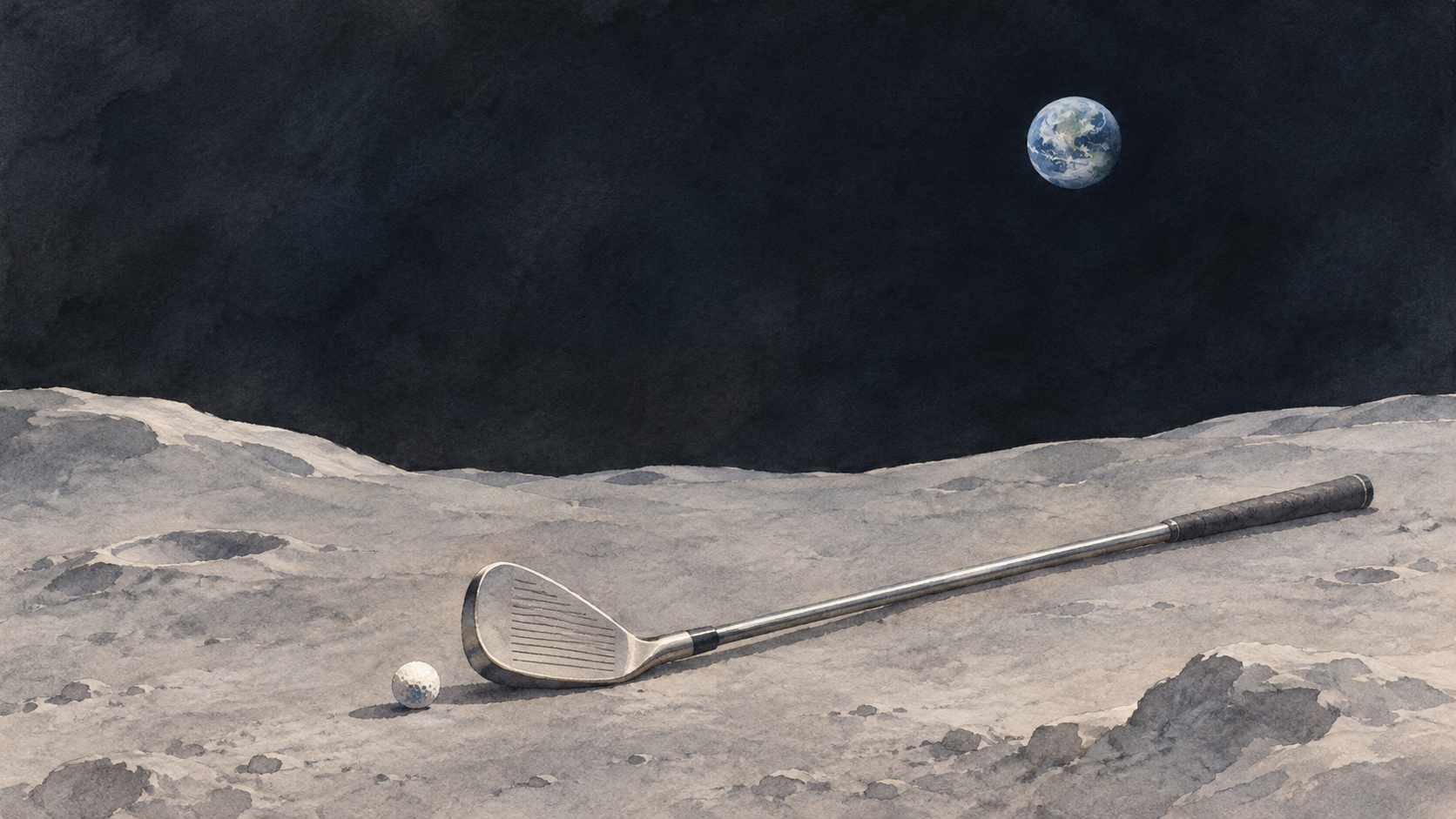
Golfers have a remarkable gift for looking at an itinerary and finding somewhere to put the clubs. Wedding weekend? There might be time. Business conference? Surely the meetings eventually stop. Family holiday? That depends on how generously everyone defines “family.”
Alan Shepard took this instinct considerably farther.
On February 6, 1971, near the end of Apollo 14’s second moonwalk, he produced a makeshift six-iron and hit two golf balls on the lunar surface. Fifty-five years later, it remains a magnificent example of a man refusing to let an inconvenient destination interfere with his interests. [1]
A very compact travel set
The equipment had required some thought. The USGA’s account describes a modified Wilson Staff six-iron head attached to a lunar sampling tool. Houston professional Jack Harden helped with the club, and Shepard carried the head and balls in a tube sock. [2]
A tube sock. Somewhere, a luxury luggage designer has just dropped his espresso.
Shepard had also sought permission from NASA official Bob Gilruth, agreeing to cover the golf equipment’s cost and attempt the shots only if the mission went well. [2] Sensible priorities. Finish the work, then see whether there’s time to get a few in. Every golfer who has negotiated a holiday round understands the principle, although most of us have never needed clearance from Mission Control.
Even the Moon has a short game
His spacesuit was stiff enough to force a one-handed swing. The first attempts were untidy, which makes this one of the more reassuring achievements in sporting history. Humanity had mastered the lunar landing and still occasionally hit it fat.
Then came the famous claim that a ball had gone “miles and miles and miles.” NASA’s later historical account gives the distances as approximately 24 yards for the first ball and 40 for the second. [1]
That feels familiar. A golf shot improving in the telling, only this time with a worldwide audience and rather better documentation.
Forty yards is perfectly respectable when your outerwear doubles as a life-support system. It also establishes that even escaping Earth’s gravity does not guarantee the distance you imagined when you bought the equipment.
The souvenir worth keeping
The club came home. The USGA records its donation at the 1974 U.S. Open at Winged Foot and its place in the USGA Golf Museum collection in New Jersey. [2] There are golf souvenirs, and then there is the implement you used to turn another celestial body into a practice area.
Shepard’s birthday falls on November 18, a useful excuse to revisit the footage. [3] Watch it for the absurdity, certainly, but also for the pleasure. An astronaut, surrounded by the machinery of an extraordinary mission, found a moment for something he loved.
That may be golf’s most portable luxury: the ability to make a little room for play, even when the schedule appears quite full.
The next time somebody questions whether the clubs really need to come on the trip, choose your moment carefully. Shepard is an excellent precedent.
Just remember that he packed one iron. Your argument may weaken somewhere around the second pair of shoes.
Sources
[1] NASA: 50 Years Ago: Apollo 14 Lands at Fra Mauro
[2] USGA: “One Great Big Sand Trap”: 55 Years of the Moon Club
[3] NASA: Celebrating Astronaut Alan Shepard’s 100th Birthday
Image notes: The header is an original AI-generated editorial illustration, not a photograph of the Apollo mission. The archival photograph shows Alan Shepard following through on the Moon on February 6, 1971. Photo: NASA.