
Travel
Cowboys Golf Club: The Star Has a Short Game
In Grapevine, a transformed Cowboys Golf Club pairs serious golf with stadium-turf practice, The Huddle putting course and a full-day Texas welcome.
There are two kinds of golf souvenirs: the tasteful little ball marker and the thing that requires a truck. Cowboys Golf Club has taken delivery of the second kind. Its renovated driving range incorporates 60 yards of game-used turf from AT&T Stadium. Apparently, a signed jersey would have lacked ambition.
That gives you some idea of the proposition in Grapevine, Texas. The Dallas Cowboys connection is right there in the name, but the address matters: this is Grapevine, in the Dallas–Fort Worth area, rather than Dallas proper. Set your navigation accordingly. Texas is a remarkably poor place to discover that your geographical approximation has added another half-hour to the morning.
Cowboys Golf Club is public-access golf with a very recognizable allegiance. The club bills itself as the world’s only NFL-themed golf club. You can understand the temptation to dismiss that as an elaborate merchandise opportunity with bunkers attached. Look a little closer at the current offering, though, and the conversation becomes considerably more interesting.
First, Give the Architects Their Due
The original course opened in June 2001, designed by Jeff Brauer. That is the historical foundation. The latest transformation involved Beau Welling and Arcis Golf’s design and construction team; the club’s current account describes Arcis leading the redesign in consultation with Welling. Those are different chapters, and both names belong in the story.
Arcis announced on March 17, 2026, that the club had reopened following its multimillion-dollar transformation. The doors are open, the new facilities are in play, and public tee times are available. For the visiting golfer, that makes this a proposition to investigate now rather than another promising rendering of somebody’s future plans.
The work reaches well beyond changing the upholstery and calling it a renaissance. Redesigned greens, repositioned bunkers and reconstructed, squared-off tees alter the actual golf. The putting surfaces use Tif3D Bermuda, and the club describes more varied pin positions and shot options. This is where the football branding has to step aside and let architecture do its job.
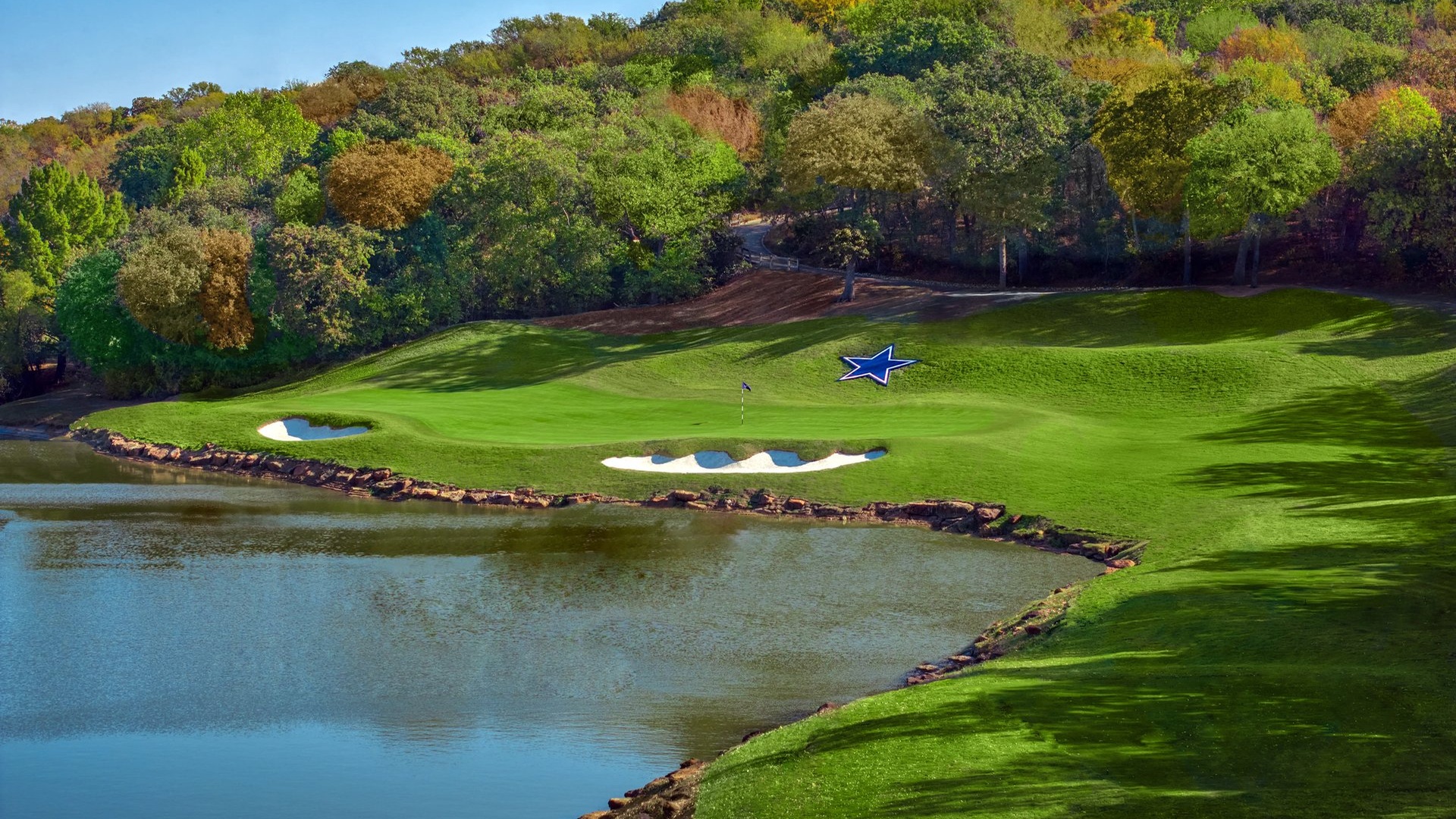
A star can tell you where the club’s allegiance lies. It cannot tell you which side of a green leaves a manageable next putt. Golf remains stubbornly resistant to brand loyalty. You may have supported the Cowboys since childhood; a bunker will still accept your ball without checking your credentials.
The official course photography makes another point that a football-themed description can obscure. There are trees, slopes, water and generous stretches of landscape here. On the photographed par-three third, the star sits on a hillside beyond the green, while the water occupies a much more consequential position in the foreground. The logo may catch your eye first. It would be wise to let the actual golf shot have your attention next.
Think of the star as the opening credits. You still have to sit through the film, and your seven-iron is responsible for the plot. Some days it produces a beautifully controlled drama. Other days the whole thing appears to have been directed by the person who gave us the loudest car chase in the franchise.
The sensible way to approach the course is to study those new decisions rather than arrive carrying expectations formed by an older scorecard or photograph. Renovations change the conversation. Familiar names on the entrance sign do not guarantee familiar targets beyond it.
A Range With Its Own End Zone
The stadium connection becomes wonderfully literal at the practice ground. Along with the repurposed playing-field turf, the range has a regulation goalpost and 14 Toptracer bays. The official practice-facilities page also lists putting and chipping greens, including a greenside bunker.
There is a certain beauty to a driving range that understands golfers are perfectly capable of turning rehearsal into the main event. Give a group shot data, targets and a little competitive structure, and somebody will announce that the next ball is the one that counts. Usually immediately after the previous ball has proved inconvenient.
The technology offers a practical reason to spend time here: distances and ball-flight feedback, rather than the ancient measurement system of “that looked pretty good.” The football furniture supplies the spectacle. Together, they give the warm-up enough personality to threaten your carefully organized schedule.
For the golfer organizing a trip, that creates options beyond the standard eighteen-and-out appointment. A range session can be its own stop, or an introduction before a full round. A companion who enjoys a little competition but has no desire to spend the afternoon searching for a driver swing can participate without signing up for your entire sporting identity.
That last point deserves more appreciation than it usually receives. Golfers tend to present a four-hour commitment as though they were suggesting a quick coffee. Being able to offer a smaller version of the experience is good manners dressed up as good facilities.
One small planning distinction: practice access has its own published terms, while booked golf packages have their own inclusions. Read the package you are actually purchasing. The phrase “I assumed” has never been a particularly successful concierge strategy.
The Huddle Keeps Everyone in the Game
The Huddle is a separate 18-hole putting course, not a new name for the championship layout. That distinction is worth making before somebody packs fourteen clubs for an outing that principally requires one.
Open to the public and designed for different ability levels, it broadens the invitation. A conventional golf day can divide a group rather efficiently into people discussing carry distances and people wondering when lunch begins. Putting offers a more accessible common language. Everybody understands the objective; almost everybody believes they ought to be better at it.
For a mixed group, that is a useful luxury. The serious golfer can still enjoy the larger course while friends or family have another way into the day. The club also markets The Huddle for private events and tournament add-ons, which makes sense. A putting competition is a more promising icebreaker than asking twelve strangers to explain their handicaps.
Beside it, The Tailgate adds picnic-style seating, string lights and an Airstream bar. The current dining page describes the outdoor beer garden as open. You can see the intention: give the group somewhere to settle rather than send everyone straight from the final putt to the parking lot.
Hospitality Without the Initiation Ceremony
The Ring of Honor Kitchen & Bar carries the Cowboys connection into dining, with a Texas-influenced menu, cocktails, beer and wine. The Five Points Patio looks across the range and practice areas. The clubhouse photographs add another layer of team history to the surroundings.
The appeal of that arrangement is easy to understand. Lunch has somewhere to become a proper occasion, rather than the hurried transfer of a sandwich from its wrapper to your lap while somebody else drives the cart.
The club’s Public VIP tee-time offering currently includes the green fee, cart, GPS, premium range balls, food, snacks and nonalcoholic beverages, plus locker-room access and bag service. There is a separate Touchdown Package with additional inclusions. Confirm the details when booking, and resist the urge to translate “all-inclusive” into “every conceivable thing on the property.” Alcohol, in particular, is not included in that VIP beverage description.
Plan the Day, Then Leave It Some Room
The obvious booking question is which experience your group actually wants. Eighteen holes, a practice session, putting, a meal, or a combination? Decide that before choosing a package. A longer list of inclusions is useful only when it includes things you will use. Otherwise, it is just a beautifully printed argument for carrying home another hat.
Check current availability directly with the club, and confirm the details for your date. Ask about the course, practice access and dining arrangements, especially if you are bringing a group. A few useful questions beforehand can prevent a committee meeting in the parking lot. And allow the renovated property a fresh look: an old review may describe a different afternoon entirely.
There is room here for the devoted Cowboys fan and for the golfer whose football loyalties lie elsewhere. The latter might have to tolerate a little silver and blue. In exchange, there is an unusually broad golf-day proposition to investigate. A mature person can surely separate architectural curiosity from tribal allegiance. At least until somebody mentions last Sunday.
For an affluent golf traveler, the appeal is straightforward: a destination that lets the day develop without requiring a new plan every ninety minutes. Play, practice, putt, eat, argue good-naturedly about sport. The Cowboys branding gives the property its identity; the breadth of the experience gives a group reasons to stay.
The best itinerary leaves a little slack for the unexpected contest, the second conversation and the person who suddenly discovers putting. You booked a day out, after all, rather than a military exercise with better trousers.
Just remember that the regulation goalpost is scenery for your golf outing, not a revised set of scoring rules. A ball through the uprights remains a range ball. Tempting as it may be to award yourself three points.