
A Round With...
A Round With… Cheryl Hines
In memory of Wil Barnes There are golf days you remember because you made a birdie. There are golf days you remember because the wind was blowing so hard it tried to steal your scorecard and relocate it to Catalina. And then there are days when you find yourself riding around Ocean Trails in a golf cart with Cheryl Hines, shooting photos while she makes the entire business feel like less of a business and more like a day off somebody cleverly got reimbursed for. That was one of those days.
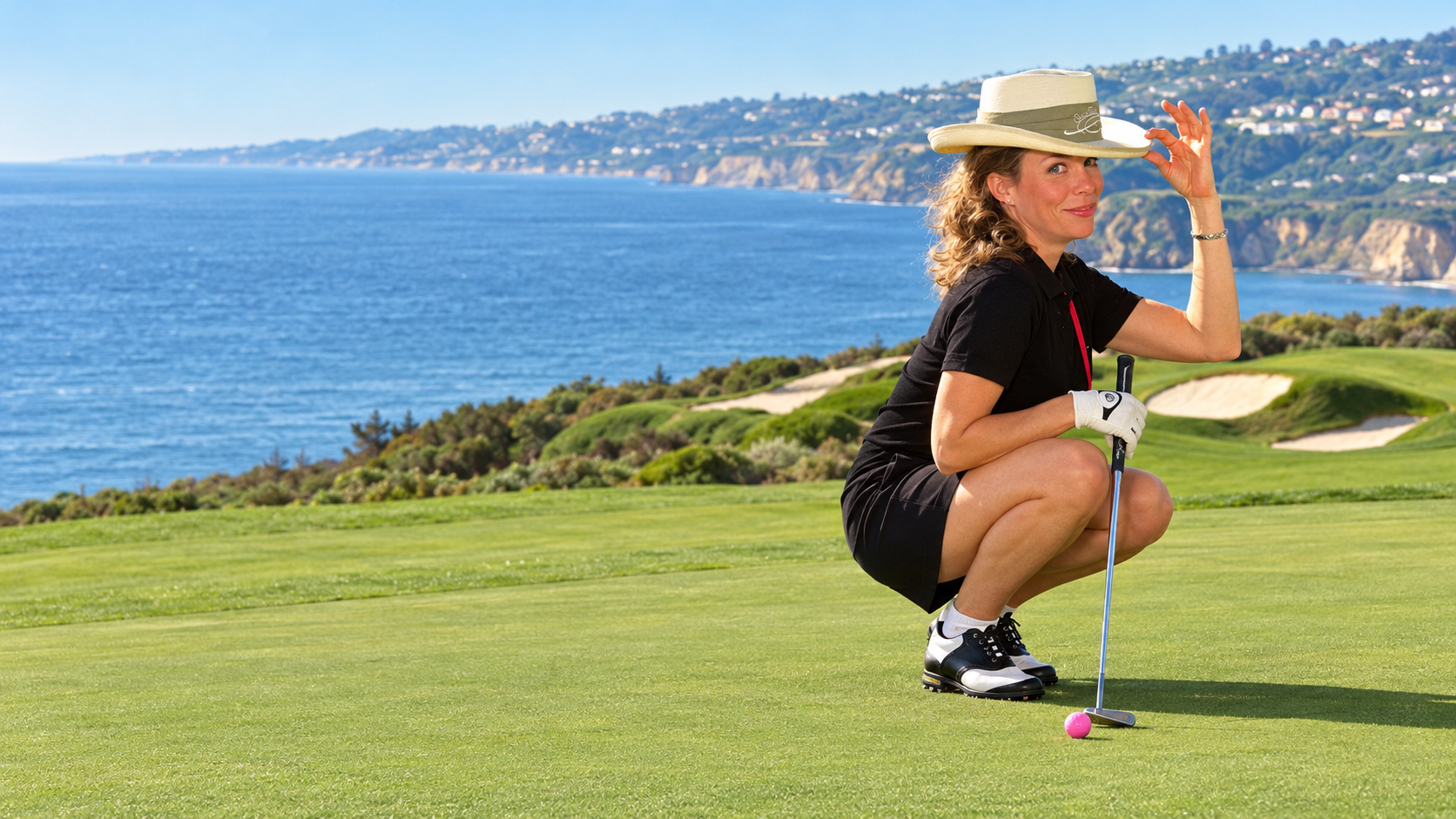
Originally reported by Wil Barnes | Photography and updated story by Dean Kirkland The original story ran in 2002, when Cheryl Hines was beginning to break through on HBO’s Curb Your Enthusiasm, Ocean Trails was still Ocean Trails, and a round of golf in Palos Verdes did not yet come with the Trump name stamped on the gate. Today, Cheryl is married to Robert F. Kennedy Jr. The course is Trump National Los Angeles. Life has a sense of humor that would have made Larry David stop, look at the camera, and walk out of the room. But the day I remember had nothing to do with politics, headlines, or any of the nonsense that comes later. It was a sunny afternoon at a spectacular oceanfront course with Cheryl Hines, a golf cart, my cameras, and Wil Barnes writing the story. Wil was good at this. He did not just interview people; he got them talking. He found the interesting bits that live outside the publicity sheet—the odd jobs, the family stories, the bad golf, the jokes, the parts that actually tell you who someone is. This updated piece is for him. Cheryl was a lot of fun that day. Easygoing, funny as hell, and completely willing to laugh at herself. That is a rare commodity in Los Angeles, where many people arrive with a publicist, a skin-care schedule, and the emotional flexibility of a marble bust. At the time, she was becoming known as Larry David’s wife on Curb Your Enthusiasm—the relatively sane person in a world built around Larry’s special ability to turn an ordinary afternoon into a five-alarm social disaster. Cheryl said she loved working with him because she often did not know what the scene was until she was already in makeup. Larry would tell her just enough, and then she would improvise her way through it. That worked because Cheryl had spent years doing exactly that. Before Los Angeles, before HBO, and before television audiences knew her name, she was in Florida working at Universal Studios. Her job included reenacting the shower scene from Psycho—putting on a flesh-colored body suit and getting “stabbed” in front of roughly 300 people, fifteen times a day. That is a résumé item you do not hear at the country club every day. She also worked with the Groundlings, the Los Angeles comedy group that has launched enough careers to make an agent weep into his sushi. Her one-woman show drew strong reviews, and her television credits already included Seinfeld, Suddenly Susan, The Wayans Bros. and Oh, Baby. But even then, with Curb picking up steam, she was still grounded, still quick, and still happy to be out playing golf on a Friday afternoon. Golf had been part of her life for years. Cheryl grew up in Florida, where much of her family played. Every Christmas, they held their own family tournament, and she usually partnered with her father. Her younger brother Michael was, according to Cheryl, probably the best player in the family—which is exactly the kind of thing a younger brother should be required to prove every Christmas until somebody gets tired of it and starts serving bourbon. She first tried golf in high school and thought it was slow and boring. Fair enough. A lot of people reach that conclusion after watching someone spend seven minutes lining up a two-foot putt. But later, while studying radio and television at Central Florida University, she took a golf course, learned what the game was asking of her, and got interested. By the time we met at Ocean Trails, she had played for about twelve years. She usually played around Los Angeles at Griffith Park or Rancho Park’s par-three course, but Ocean Trails was something else entirely. The Pacific sat just beyond the fairways, the wind moved through the property, and Pete Dye’s bunkers waited around the course like they had been built by a man with a personal grudge. Cheryl looked out over the coastline and said, “Wow, it is really beautiful out here. I could get used to this.” She settled in after a nervous start and hit some good shots. On the par-four sixth, she striped a six-iron to about twelve feet and made the birdie putt. That was one more birdie than I had, which I did not appreciate at the time and have chosen to remember inaccurately ever since. Then came the wagers. On the par-three fourth, I had a long, double-breaking putt—about forty feet. Cheryl offered ten dollars if I made it. I did not. Somewhere later in the round, she spotted the beverage cart and proposed a new arrangement: whoever won the next hole got a Bloody Mary. We tied. Naturally, we had one anyway. “It’s Friday afternoon,” she said. “Work is over for the week.” That was Cheryl all day. Loose, funny, and perfectly happy to let golf be golf instead of an audition for the U.S. Open. The deep bunkers gave her trouble now and then, but bad shots never seemed to ruin the day. She laughed through them, which is how the game ought to be played by everyone not being paid to wear a logo on their collar. During the photo shoot, she grabbed a hat from the pro shop, climbed up on a table, and announced that it was her “Titanic shot in golfing.” Then she wobbled, laughed, and carried on as if the whole place had been rented for her own private comedy bit. That is the person Wil captured in his original story. Not a television character. Not a headline. Cheryl Hines, having a good time on a beautiful course, with the ocean behind her and no apparent interest in taking herself too seriously. And that, even now, is the best part of the story.